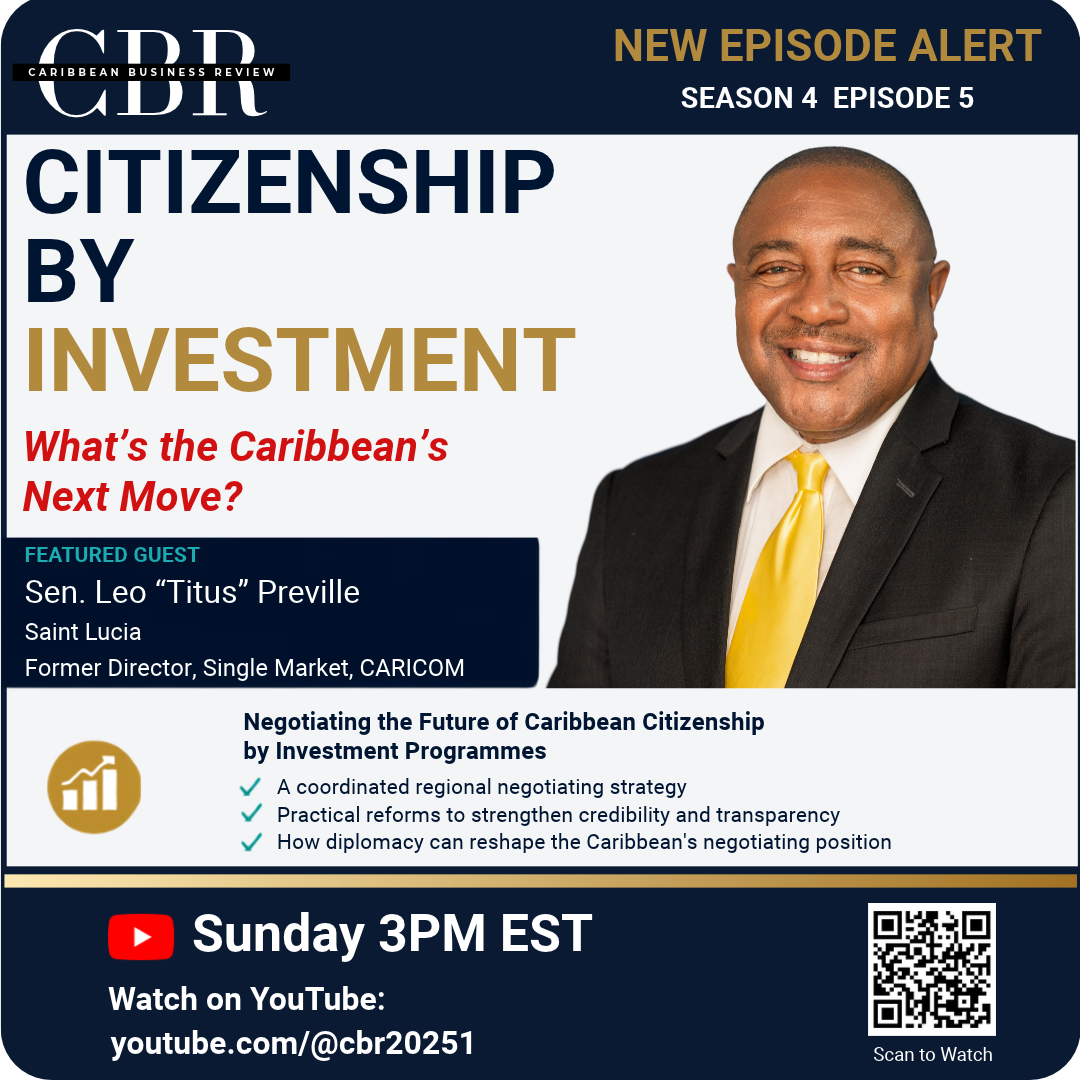
Caribbean Business Review · Season 4, Episode 5
Citizenship by Investment: Negotiating the Caribbean’s Next Move
Leo “Titus” Preville · Opposition Senator in Saint Lucia; former Director of the CARICOM Single Market
Broadcast:
Episode Overview
As the European Union moves towards its stated June 2028 deadline for Citizenship by Investment (CBI) programmes, the OECS faces a consequential economic and diplomatic challenge. How can governments manage the transition without undermining fiscal stability, while building more resilient and diversified economies?
Opposition Senator Leo "Titus" Preville of Saint Lucia, former Director of the CARICOM Single Market, joins Joseph Cox to examine the strategic options available to the region. Their conversation focuses on the sequencing of economic adjustment, the importance of coordinated diplomacy and the institutional reforms needed to strengthen long-term resilience.
A central distinction emerges between the immediate requirements of fiscal stability and the longer-term objectives of economic transformation. Governments must protect their fiscal positions while developing credible pathways towards diversification. The challenge is not simply to identify alternative economic activities, but to establish an adjustment process that avoids destabilising public finances before new sources of growth and revenue can be developed.
Regional diplomacy is equally important. A unified OECS and CARICOM response could strengthen the Caribbean's negotiating position with the European Union, reinforce the credibility of its commitments and improve the prospects for a coordinated approach to adjustment. The discussion also considers opportunities arising from the current diplomatic engagement process, alongside the importance of greater transparency and institutional reform.
Preville's analysis places the immediate CBI debate within a wider question of economic resilience. Preserving existing programmes cannot be the ultimate objective of regional strategy. The more consequential challenge is to use the available period to strengthen productive capacity, diversify economic activity and reduce the vulnerabilities associated with concentrated revenue dependence.
The discussion therefore moves beyond the future of Citizenship by Investment itself. It examines how small Caribbean states can develop the institutional capabilities, regional coordination and strategic adjustment capacity required to navigate an increasingly uncertain geopolitical and economic environment.
Three Strategic Takeaways
1. Fiscal stability must precede economic transformation.
Governments must first preserve fiscal stability before pursuing long-term diversification and structural reform. The sequencing of adjustment is therefore critical.
2. Regional coordination is now a strategic imperative.
A unified OECS and CARICOM response can strengthen diplomacy, credibility and the region's negotiating position.
3. The goal is resilience, not simply preserving CBI.
The real challenge is using this period to build stronger, more diversified and less vulnerable Caribbean economies.
CBR Assessment
The strategic significance of the June 2028 deadline extends beyond the future of Citizenship by Investment programmes. It raises fundamental questions about the capacity of small states to manage externally driven economic adjustment without compromising fiscal stability or surrendering long-term development opportunities.
The central test is whether Caribbean governments can combine credible regional diplomacy with an orderly adjustment strategy that strengthens economic resilience and institutional capacity.
Episode artwork