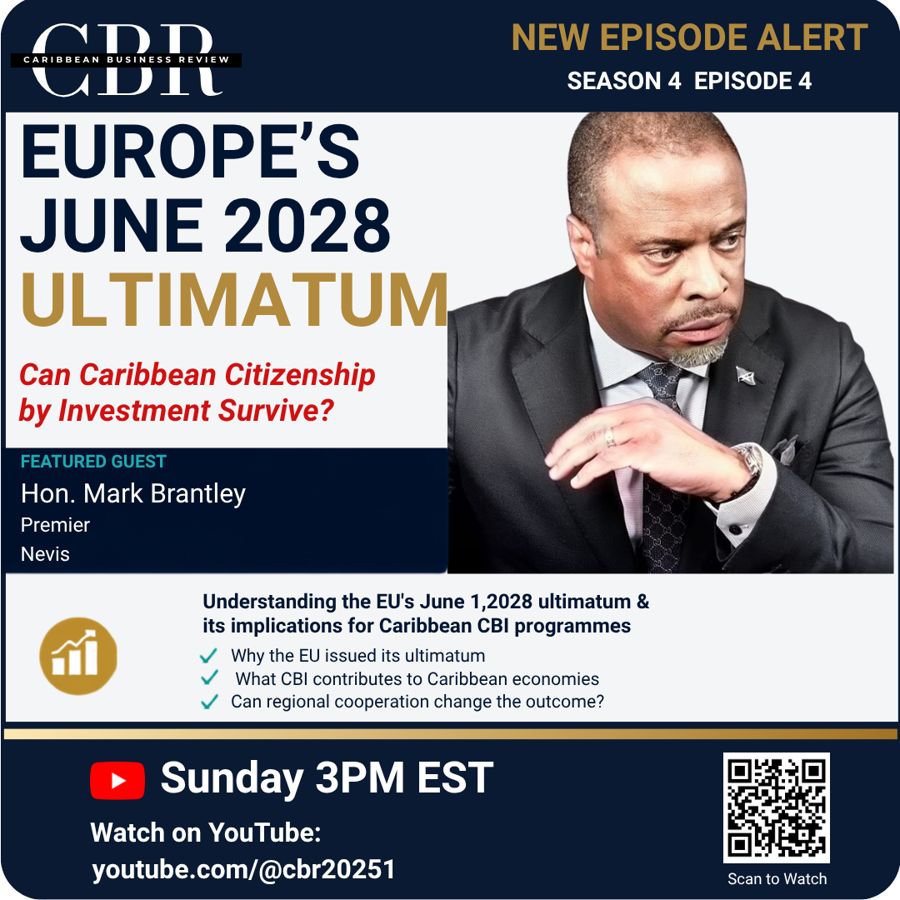
Caribbean Business Review · Season 4, Episode 4
Europe's June 2028 Ultimatum: Can Caribbean Citizenship by Investment Survive?
Can Caribbean Citizenship by Investment Survive?
Dr. the Hon. Mark Brantley · Premier of Nevis and Leader of the Opposition in St. Kitts and Nevis
Broadcast:
Episode Overview
As the European Union intensifies pressure on Caribbean Citizenship by Investment (CBI) programmes ahead of its stated June 2028 deadline, the region confronts a challenge extending well beyond immigration policy. For countries that have come to rely on CBI receipts to support public finances and development expenditure, the implications are potentially significant. The question is how Caribbean governments can protect their immediate economic interests while reducing the structural vulnerabilities associated with dependence on a revenue source increasingly exposed to external policy decisions.
Dr. the Hon. Mark Brantley, Premier of Nevis and Leader of the Opposition in St. Kitts and Nevis, joins Joseph Cox to examine the diplomatic, economic and institutional choices confronting the region.
A central argument is that fragmented national responses weaken the Caribbean's negotiating position. Individual small states possess limited leverage when confronting major international partners. Brantley makes the case for stronger collective diplomacy through CARICOM and the OECS, arguing that a coordinated regional position offers greater prospects for securing realistic transition periods, meaningful concessions and recognition of the economic circumstances of affected countries.
The importance of transition arrangements extends beyond obtaining additional time. An abrupt disruption to CBI receipts could constrain fiscal flexibility, complicate public investment planning and intensify adjustment pressures before alternative revenue sources are established. The challenge is therefore to secure sufficient policy space for governments to undertake a deliberate economic transition rather than respond through potentially destabilising short-term measures.
Yet Brantley's argument does not rest solely on defending existing programmes.
The more fundamental challenge is how governments use the revenues still available to reduce their future dependence on CBI. He advocates directing these resources towards economic diversification and productive investment, including renewable energy, technology, creative industries and infrastructure. The objective is to transform revenues derived from a potentially temporary financing mechanism into assets and capabilities capable of generating sustainable economic activity.
This distinction is consequential. CBI receipts can provide fiscal resources, but their availability does not automatically translate into stronger productive capacity, export competitiveness or durable economic resilience. The economic value of these programmes must therefore also be assessed by what governments have been able to build with the revenues they generate.
The conversation ultimately connects economic sovereignty with institutional and productive resilience. Policy autonomy cannot be sustained indefinitely through dependence on a revenue instrument whose future is substantially influenced by decisions taken outside the region.
For Brantley, collective diplomacy and economic transformation are complementary rather than competing strategies. The first seeks to preserve the time and negotiating space necessary for adjustment. The second addresses the underlying vulnerabilities that make external pressure so consequential.
Three Strategic Takeaways
1. Regional unity strengthens negotiating leverage.
A coordinated CARICOM and OECS response can improve the Caribbean's ability to negotiate realistic transition arrangements and defend the legitimate economic interests of small states.
2. CBI revenues must finance productive transformation.
Governments should use available receipts to strengthen diversification, infrastructure and productive capacity, rather than allow temporary revenue flows to reinforce long-term fiscal dependence.
3. Economic sovereignty requires resilience.
Preserving policy autonomy ultimately depends on reducing concentrated vulnerabilities, strengthening institutions and developing more durable sources of economic growth.
CBR Assessment
The European Union's stated June 2028 deadline presents an immediate diplomatic challenge, but it also exposes a deeper question about the sustainability of development models dependent on externally vulnerable revenue streams.
The effectiveness of the Caribbean's response will be judged not simply by whether existing CBI arrangements can be preserved or extended, but by whether governments use the available negotiating space and financial resources to establish more resilient economic foundations.
The strategic objective must therefore extend beyond protecting Citizenship by Investment to reducing the economic dependence that makes its potential loss so consequential.
Episode artwork